Note
The model does not remember. It works with context.
When working with AI, it is easy to confuse context with memory. That mistake can lead to wrong expectations, misplaced trust and poor decisions.
TL;DR
A model can feel continuous in conversation, but it does not remember a situation the way a person does.
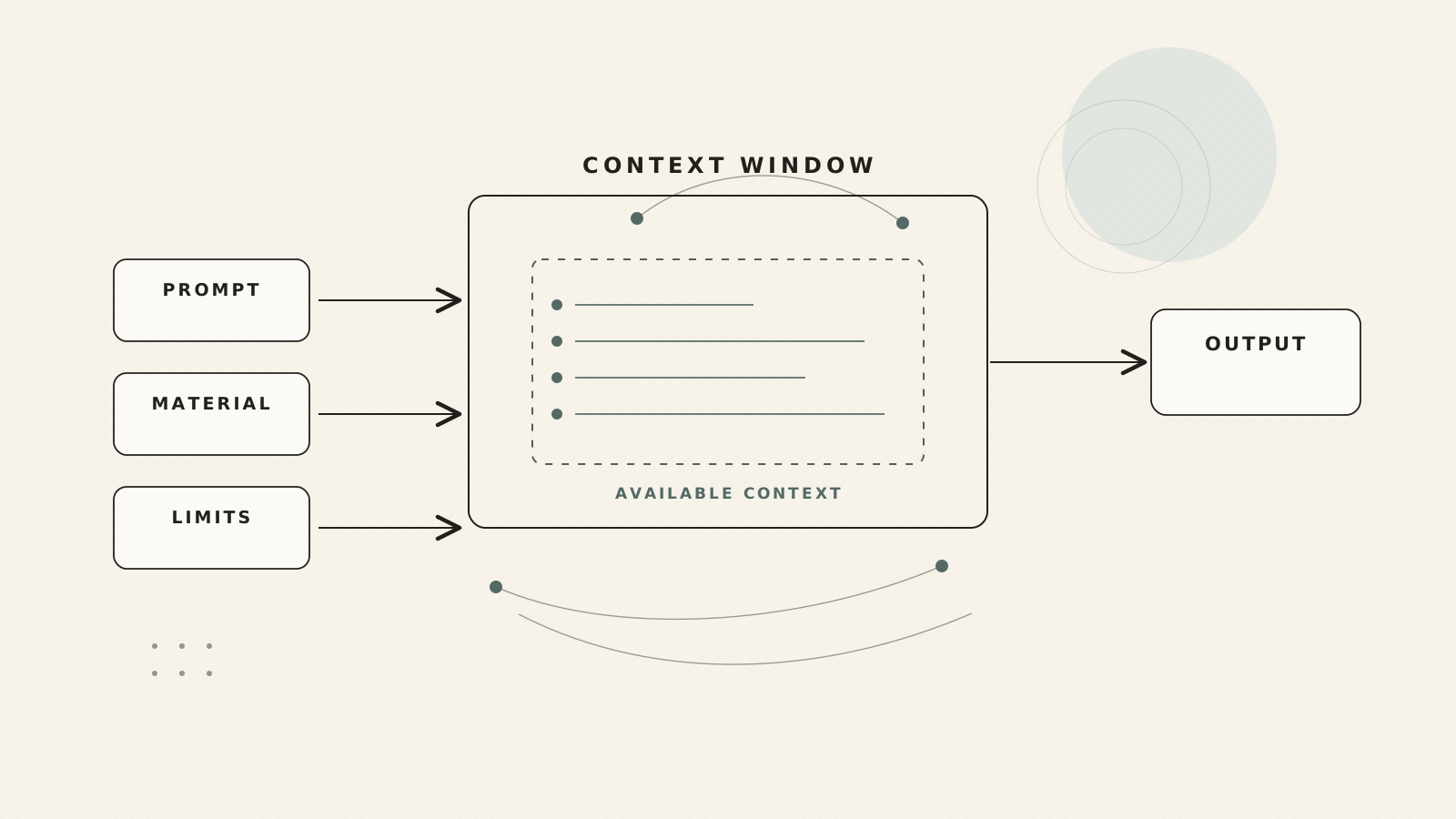
It works with available context: the prompt, previous turns, pasted material and constraints.
When users confuse context with memory, they may omit important information or trust the answer too much.
Working well with AI means actively managing context and checking the result before using it.
People quickly started saying that AI “remembers”, “knows what we mean” or “understands the previous conversation”. The shortcut is convenient. In a chat interface, continuity can feel very real. The system refers back to earlier messages, keeps the topic in view, summarizes what has already been said and sometimes gives the impression that it understands the situation beyond the immediate prompt.
But the shortcut can mislead. In practical AI work, context is a more useful idea than memory. A model does not remember the world, a project or a conversation in the way a person does. It works with the input available in the current interaction: the prompt, previous turns, pasted material, tool instructions and anything else that fits within the system’s usable context.
That distinction matters. If a user assumes that the model “knows”, they may stop saying what the model actually needs. If they assume that it “remembers”, they may omit constraints, changes of purpose, important documents or organizational context. And if they treat the answer as the result of full situational understanding, they can end up handing part of their judgment to a system that was working with less than they imagined.
Memory is a misleading metaphor if we use it too quickly
Human memory is not only storage. It is tied to experience, emotion, relationships, time, place and consequence. A person remembers not only a sentence, but who said it, why it mattered, what was uncertain, what changed afterwards and what responsibility came with the decision.
A language model works differently. We do not need a detailed technical account to notice the practical difference. The model generates an answer from what is available in the current context. If relevant material is not there, the system does not have stable access to it in the ordinary human sense of remembering a situation.
This is why the idea of a context window matters more than loose talk about memory. A context window defines the amount of text and instruction a model can use when generating an answer. It may include the current prompt, previous messages, fragments of documents and system instructions. It is not the same as a person’s memory of a shared situation.
When we use the memory metaphor too quickly, we make the machine feel closer to human continuity than it is. A better question is simpler: what exactly did the model receive?
What actually enters the answer
An answer does not come from the prompt alone. The prompt is the visible entry point, but the situation includes more than that. The model may also draw on earlier turns, pasted source material, examples, constraints, formatting instructions, app behavior and the way the user guides the exchange.
Tokens matter here because they are the units through which the model processes text. They affect length, cost, context limits and how much material can realistically be handled in a given interaction. When there is too much material, adding more text is not always a better solution. It can make the situation harder to read.
It helps to think of context as working material, not as unlimited memory. The user decides what to show, what to leave out, what to summarize, what to quote directly and what to mark as important. Those choices shape the model output as much as the question itself.
In organizations, this layer matters even more. A model may receive part of a brief but not the history of a client relationship. It may see a table but not the reason the data is incomplete. It may receive a task description without the social context between teams. The answer can sound coherent while resting on a thin picture of the situation.
Context is not a neutral container. It is a selection. Two teams can ask what looks like the same question and receive different quality because one team has provided criteria, sources and limits, while the other has provided only a general intention.
A wrong mental model of AI changes decisions
Every user has a mental model of AI: an internal idea of what the system is, what it can do, what it cannot do and how its answers should be interpreted. That model may be technical, intuitive, skeptical or highly humanized.
If the user thinks the model knows more than it has been given, they may delegate too much. They may ask for a recommendation without naming criteria. They may treat a summary as analysis. They may accept an answer as confirmation of their own intuition, even though the system was working from incomplete material.
If the user thinks the model understands a situation like a person, they may omit information that would be obvious only to someone who knows the story. The model does not have that story unless it has been placed in context or made available through the particular tool being used.
This is where trust begins to shift. Calibrated trust is neither constant suspicion nor automatic confidence. It means matching trust to the task, the stakes and the quality of context. The larger the consequence, the more important it becomes to ask what the answer is actually based on.
Context can help, but it can also overload
It is tempting to assume that more context is always better. Sometimes it is. A model that receives the goal, audience, constraints, examples and source material can answer more usefully than a model that receives one vague sentence.
But more context does not automatically mean a better answer. Poorly chosen context can create noise. Long material can bury the central point. Contradictory instructions can pull the answer in different directions. Unstructured notes can produce a polished text built on a weak hierarchy of information.
This increases cognitive load. The user is not only asking a question. They must decide what to include, what to leave out, how to mark importance, how to verify the result and whether the answer relied on a fragment that was less important than it seemed.
Good AI work is therefore not just adding information. It is organizing information. Context needs structure: goal, source status, criteria, constraints, uncertainties and limits on what the model should not assume.
Sometimes less material, clearly framed, is better than more material loosely pasted. A short paragraph that names the goal, audience and evaluation criteria can be more useful than ten pages of unsorted notes.
Good AI work is context work
The question is only the beginning. Mature AI work means setting up a situation in which the answer can be useful and assessable. The user has to name the goal, provide the relevant material, mark boundaries, describe the audience and plan how the result will be checked.
This is part of AI literacy. It is not only the ability to write clever prompts. It includes understanding how a model uses context, when an answer needs a source, when to return to the original document and when to begin by clarifying one’s own question.
Metacognition helps here. In AI work, it means asking: do I know what I am looking for? Have I given the model enough information? Am I expecting it to know something I have not provided? Does the answer solve the problem, or does it only sound like a solution?
Context work is not an add-on to prompting. It is the practice of arranging the relationship between a person, a system, a task and a decision. In that sense, Human-AI Interaction begins before the user presses enter.
Trust begins with the question: what did the model actually receive?
Before trusting an answer, it is worth pausing over a few simple questions. What is this answer based on? What did the model not receive? What should be checked outside the conversation? Where does context end and inference begin?
This is not a ritual of distrust. It is epistemic vigilance: attentiveness to information, its source, its limits and the reasons it feels credible. A model can generate text that is calm, coherent and persuasive. That form does not tell us by itself whether the answer has enough support.
The model does not remember the way a person does. It works with context. That is why mature AI work begins not with a magic prompt, but with understanding what we actually give the model to work with.
For the wider map of model, product and organisation, see the note OpenAI, ChatGPT, GPT and LLM: What Is the Difference?.
References
- Anthropic. (n.d.). Context windows. Claude Platform Docs. Retrieved July 2, 2026, from https://docs.anthropic.com/en/docs/build-with-claude/context-windows
- Gentner, D., & Stevens, A. L. (Eds.). (1983). Mental models. Lawrence Erlbaum Associates.
- Lee, J. D., & See, K. A. (2004). Trust in automation: Designing for appropriate reliance. Human Factors, 46(1), 50-80.
- Norman, D. A. (1983). Some observations on mental models. In D. Gentner & A. L. Stevens (Eds.), Mental models (pp. 7-14). Lawrence Erlbaum Associates.
- OpenAI. (n.d.). Key concepts. OpenAI API documentation. Retrieved July 2, 2026, from https://developers.openai.com/api/docs/concepts
- OpenAI. (n.d.). What are tokens and how to count them? OpenAI Help Center. Retrieved July 2, 2026, from https://help.openai.com/en/articles/4936856-what-are-tokens-and-how-to-count-them
- Sperber, D., Clément, F., Heintz, C., Mascaro, O., Mercier, H., Origgi, G., & Wilson, D. (2010). Epistemic vigilance. Mind & Language, 25(4), 359-393.
- Sweller, J. (1988). Cognitive load during problem solving: Effects on learning. Cognitive Science, 12(2), 257-285.
Suggested citation
Mamczur, F. (2026, March 28). The model does not remember. It works with context. Prompted Psyche. https://promptedpsyche.com/notes/the-model-does-not-remember-it-works-with-context/
© 2026 Feliks Mamczur / Prompted Psyche. All rights reserved. Short quotations are permitted only with attribution to the author, the title and a link to the source.