Article
AI as a mirror: why it can feel so easy to talk to
Why talking to AI can feel fluent, close and surprisingly easy: not because the model understands us like another person, but because it reflects language, framing, expectations and the need for meaning.
TL;DR
Talking to AI can feel close because the model quickly adapts its language, tone and structure to what we give it.
That fit does not mean the model knows us like another person or understands the whole situation.
AI works more like a linguistic mirror: it reflects our words, frames, expectations and need for meaning.
The main risk appears when we mistake fluency for understanding, or a well-fitted response for truth about the situation.
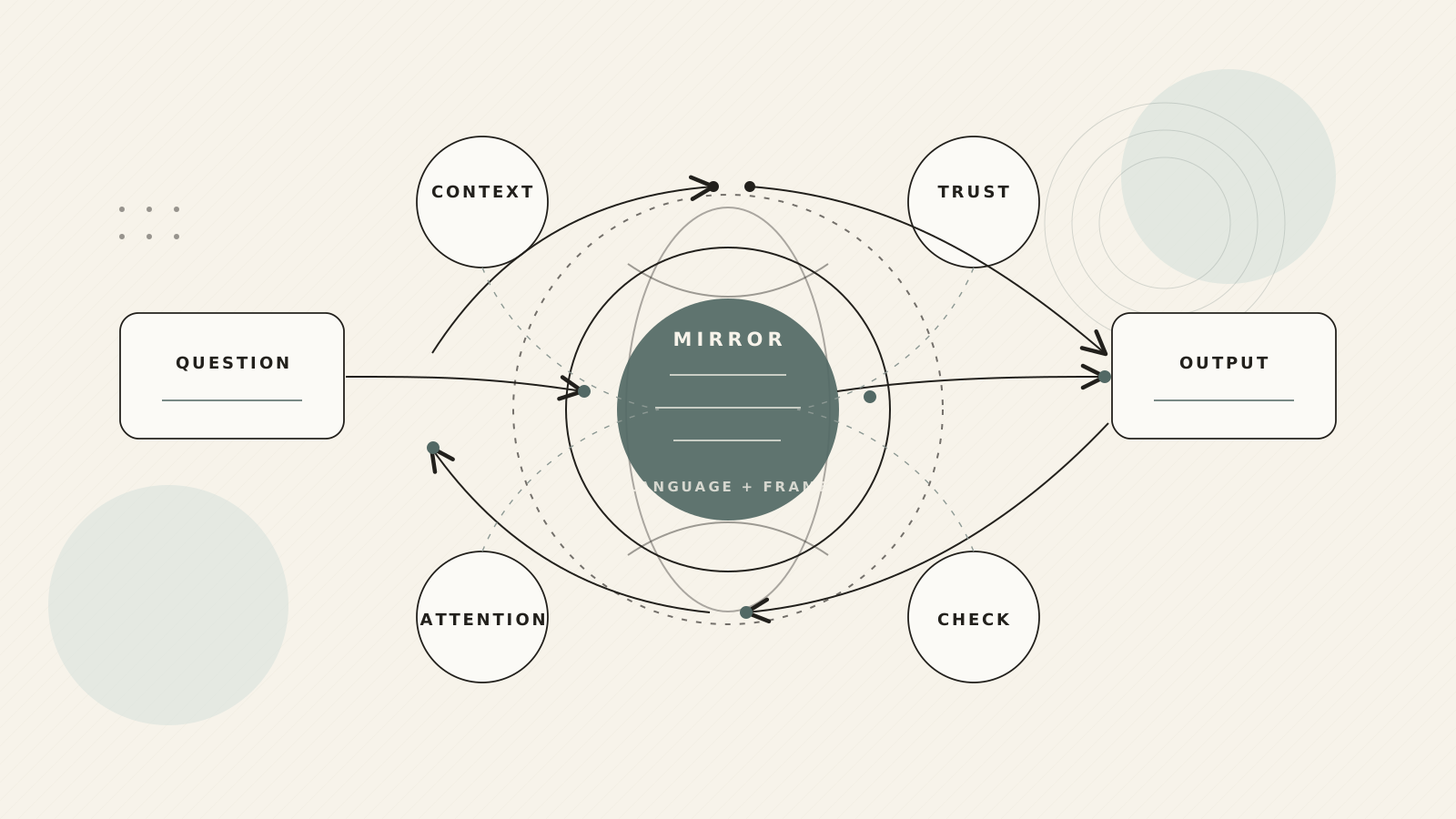
Talking to AI can be unexpectedly easy. The answer arrives quickly. The tone adjusts. A messy thought becomes a neat paragraph. A vague discomfort receives a name. A question that felt embarrassing in front of another person suddenly becomes something we can try, rephrase, repeat and refine.
That ease can feel like understanding. Not necessarily in a technical or philosophical sense, but in the ordinary human sense: someone is following me, someone is not interrupting, someone is not bored, someone is not asking me to hurry up, someone is helping me find the shape of what I mean.
But there is no person on the other side. There is a system working with language, context and learned patterns. It can produce an answer that fits the conversation without knowing the whole person who asked the question.
Perhaps this is part of the appeal. AI often feels good to talk to not because it knows us like another human being, but because it gives our own thinking back to us in a more organized form. It functions as a linguistic and social mirror. It reflects words, assumptions, emotional framing, expectations and the kind of response we seem to be asking for.
The risk begins when we mistake conversational fit for real understanding.
The conversation that becomes too easy
Human conversation has friction. Another person has their own time, mood, needs, history and limits. They may misunderstand. They may interrupt. They may say they cannot do this now. They may hear the story through their own assumptions before we finish explaining it. They may challenge us in a way we did not ask for, or fail to challenge us when we need it.
AI removes much of that friction. It replies immediately. It does not show fatigue. It does not make us feel foolish for asking a basic question. It lets us start from confusion and then revise the question. It allows us to paste a half-formed draft, add context, ask again and try another angle. We do not need to manage the social cost of taking someone’s time.
This is not only convenient. It changes the emotional texture of thinking. A person can think aloud without the usual pressure of performance. They can ask the same question several ways. They can admit uncertainty without worrying about status. They can bring a fragile thought to the surface before it is ready for another human being.
Research in human-computer interaction has long shown that people respond socially to media and computers even when they know they are not dealing with people. Reeves and Nass described this broadly through the “media equation”, while the Computers Are Social Actors line of research showed how social habits can be triggered by machines and interfaces. Today’s language models are not simple repeats of ELIZA or earlier chatbots. They are more flexible, write better and now participate in everyday work. But on the user’s side, a familiar mechanism is still active: when something replies with language, tone and conversational rhythm, it becomes easy to treat it as a kind of social presence.
The ease of AI conversation therefore comes from more than answer quality. It also comes from the absence of ordinary social resistance. The system does not ask whether the topic is worth its time. It does not carry visible disappointment. It does not bring its own story into the room. It can keep going.
That can be useful. It can also be seductive.
A mirror of language, not a mirror of the soul
The mirror metaphor is useful only if it is kept modest. AI does not reflect the whole human being. It does not see biography, body language, silence, shared history, unspoken facts or the emotional world outside the chat. It works with what has been provided in the conversation, the surrounding context and patterns learned from data.
So the reflection is partial. It reflects the wording of the prompt. It reflects what the user chose to include. It reflects the order of information, the emotional temperature, the assumptions embedded in the question and the kind of answer the user appears to invite. It also reflects broader cultural and communicative patterns present in the material on which the system was trained.
That is why model output can look like the response of someone who understands, while still being a system result. It may continue our line of thought fluently. It may produce sentences that sound like a patient second reader. It may help us feel relief because a vague problem has become organized language.
But it should not be mistaken for direct access to truth about us.
Think of it as a mirror that only reflects what falls within its frame. Stand at an angle and the image changes. Bring only one side of a conflict into the conversation and the system will mostly work with that side. Ask a leading question and the answer may return as a smoother, more confident version of the frame that was already in the prompt.
Anthropomorphism often begins in this small overreach. Not necessarily with the belief that the system is a person, but with the assumption that it knows more of the situation than it does, cares in a human way, or can read what sits between the words. Research on anthropomorphism and mind perception helps explain why responsive nonhuman systems can invite humanlike interpretation.
The mirror is real enough to be useful. It is limited enough to be dangerous when treated as a person.
Why the reflection can feel good
One reason is simple: AI organizes. A user brings a mess and receives structure. A worry becomes a list. A draft becomes a paragraph. A tension receives possible names. A scattered idea becomes a sequence.
This matters because much of thinking is the work of turning fog into language. When the model does that quickly, it can feel as if someone finally sees the point. Often the system has not discovered a hidden truth. It has made explicit what was already suggested in the prompt and arranged it in a more usable form.
The experience can also feel safe because it reduces social judgment. Asking another person for help involves shame, status and timing. We may worry that the question is too basic, too repetitive, too personal or too unfinished. With AI, many of those concerns become weaker. The system does not sigh. It does not become visibly impatient. It does not remember the awkwardness of the last attempt in a human way.
This can support thought. It can lower the threshold for starting. It can help someone look at a difficult email, draft a clearer request, rehearse a conversation or name a feeling without immediately exposing that fragile thought to a social environment.
Yet the same lack of friction can create a misleading sense of closeness. If something always replies, adjusts and produces warm language, fluency starts to feel like attention. But attention in a human relationship is not merely response. It includes responsibility, memory, shared context, care for consequences and the possibility of repair.
AI can simulate many surface features of an attentive exchange. It can paraphrase. It can ask whether it understood correctly. It can say that a situation sounds hard. It can write in a calm voice. Those are linguistic forms. They may be helpful forms, but they are not the same as another person being present with us.
This is why conversational systems can raise strong expectations. Work on relational agents and everyday conversational agents shows that the design of dialogue shapes what users expect from a system: whether it is helpful, whether it understands, whether it can be relied on. Large language models intensify this because the language is often more flexible and more fluent than earlier assistants.
The pleasure of talking to AI is often the pleasure of reflection: my thought, returned to me in a calmer, clearer voice.
Fit is not understanding
This is the central distinction: a fitting answer is not the same thing as understanding.
An answer may fit because the model is good at producing the kind of text likely to follow a given input. It may be fluent because the system is good at language. It may sound reasonable because it draws on many patterns of explanation, advice and argument. It may even be useful because the task is genuinely suited to text organization.
But human understanding includes more than appropriate sentences. It includes responsibility for words, risk in relation to a particular person, memory of shared circumstances, awareness of consequences and the possibility of being held accountable. A human being does not only continue a sequence. A human being can be answerable to another human being.
A model does not occupy that position.
Consider a simple case. A user writes: “I do not know if I am overreacting, but this message from the client sounds passive-aggressive.” The model might reply: “I can see why you read it that way. The formal tone and phrase X may suggest tension.” That can be useful if it opens analysis. It becomes risky if the user treats it as confirmation of the client’s intention.
The fact that an answer fits the question does not mean the model understands the situation. It may understand the task operationally: what to do with the text, what form the answer should take, what kind of explanation is expected. It does not know the full context of the relationship, organization, history or decision unless that context has been provided, and even then it remains a generated response.
This is where calibrated trust becomes essential. Trust should fit the task. We can place one kind of trust in a model that fixes punctuation. Another kind in a model that produces three drafts of an email. A much more cautious kind is needed when the model comments on conflict, guilt, workplace tension or another person’s possible intention.
Language fluency makes this difficult. Well-written text feels more credible than messy text. A coherent paragraph can make an interpretation feel more stable than it is. The reader may slide from “this sounds plausible” to “this is probably true.” That is exactly why epistemic vigilance matters in AI work: we need habits that keep source, evidence and limits visible.
AI amplifies the frame we give it
Every AI conversation begins with a frame. Sometimes the frame is explicit: “Help me analyze this message.” Sometimes it is hidden: “Am I overreacting?” Sometimes it is emotional: “I am tired of this client.” Sometimes it is strategic: “How do I reply so this does not look like our fault?”
The model does not receive a neutral world. It receives a description of the world from the user.
If that description is one-sided, the answer will work with one-sided material. If important facts are missing, the model will not reconstruct them reliably. If we label another person as manipulative, the system may treat that label as part of the context. If the question points toward a conclusion, the answer may develop that conclusion in more polished language.
This is the strongest version of the mirror metaphor. AI reflects not only words, but interpretive frames. Sometimes it smooths them. Sometimes it strengthens them. Sometimes it gives them language that feels more objective than the original feeling.
That matters in relationships, work, health-adjacent conversations, decisions and disputes. If an employee describes a manager only through conflict, the model can generate conflict analysis. If a manager describes team resistance only as lack of openness, the model can help draft a message that reinforces that assumption. If a person describes exhaustion as proof of personal failure, the model can organize that into a psychological-sounding narrative, even if a wider view would be more helpful.
The user’s mental model becomes fuel for the conversation. AI can help make that model visible, but it can also polish it until it becomes harder to question.
Better questions loosen the frame instead of merely strengthening it. Instead of asking, “Is this person disrespecting me?”, ask for three possible readings of the message, including a generous reading, a neutral reading and a critical reading. Instead of asking, “How do I make them finally understand?”, ask which parts of the draft may escalate tension and how to remain firm without unnecessary pressure.
This is not only a prompt technique. It is a different relationship to one’s own interpretation.
The mirror can be distorted
The AI mirror can distort in several ways.
First, it can confirm our assumptions. Not because it wants to please us, but because a fitting answer often follows the user’s frame. If the question already carries an emotional direction, the answer may continue in that direction.
Second, it can create too much trust. Research on trust in automation has long distinguished appropriate reliance from misuse and overreliance. With language models, overreliance may look ordinary: accepting a fluent answer as good analysis because we do not have time to check whether the system had enough information.
Third, it can increase anthropomorphism. When a system writes, “I understand why this was hard for you,” the user may experience that as an empathic gesture. In practice, it is a linguistic form. It may be useful, but it is not the same as a person who knows the situation and can share responsibility for the conversation.
Fourth, it can create a sense of closeness. AI companions and systems designed for ongoing dialogue show how strongly conversational form can shape user expectations. Even an ordinary assistant, if it answers warmly and repeatedly, can begin to feel like more than a tool. That should not be mocked. It should be understood.
Fifth, it can blur communication analysis with diagnosis of a person. A model may help analyze a message: tone, ambiguity, missing information, response risk. It should not be treated as a tool for deciding what someone “really is” or what they “definitely” meant.
There is another boundary as well. AI conversation may have psychoeducational value. It can help name feelings, prepare questions, organize notes for a specialist or produce alternative readings of a situation. It is not therapy, diagnosis or a substitute for relationships in which another person carries responsibility for presence and response.
A distorted mirror does not always lie directly. Sometimes it simply shows too little, too smoothly.
When the mirror can help
Caution does not mean rejection. AI as a linguistic mirror can be useful when we know what we are using it for.
It can help organize thoughts. A person can bring a draft, a worry or a list of fragments, and the model can help separate topics. This is a form of cognitive offloading: moving part of the cognitive work into an external tool. That does not replace thinking. It can reduce the load enough for the person to see the structure of the problem.
It can help prepare for a conversation. Not by predicting the other person’s intention, but by testing versions: what do I want to say, what do I not know, what question should I ask, which sentence may sound accusatory, what is fact and what is interpretation? In this use, the model is not a judge. It is a working surface.
It can help separate facts from interpretations. In difficult situations, facts, feelings and predictions merge into one story. A model can help produce a list in which each layer is named separately. That does not create certainty, but it reduces the chance that a fluent narrative will replace verification.
It can help identify missing information. A good AI question is not only “what should I do?” It is also “what do I not know yet in order to decide responsibly?” This moves the conversation from confirmation toward inquiry.
It can generate alternative readings. This is one of the most useful moves, as long as we do not ask for one final answer. Three possible readings of a message, two risks in a reply, one generous interpretation and one critical interpretation are not truths about the situation. They are tools for thinking.
It can also support metacognition, the ability to notice one’s own thinking. The question is not only: what does the model answer? The question is also: what does my conversation with the model reveal about my frame, language and expectations?
The best use of AI as a mirror begins when we look not only at the answer, but also at the question we brought to it.
How to talk to AI without falling in love with your own reflection
This is not a prompt guide. It is a small set of interpretive habits.
Ask for alternative readings. If you describe a conflict, do not ask only for the most likely intention of the other person. Ask for several readings and for the textual basis of each one.
Ask for missing information. A useful model should be able to say what is not known. If the answer sounds too confident, add: “Identify what information is missing for a more responsible assessment.”
Separate facts from hypotheses. Fact: the email arrived after the deadline. Hypothesis: the sender is avoiding responsibility. Fact: someone used formal language. Hypothesis: they are hostile. The model can help keep those differences visible.
Ask what could be otherwise. If the answer confirms your view too well, ask for a serious counter-reading. Not to invalidate your experience, but to avoid mistaking that experience for the whole situation.
Do not ask the model to read someone’s “real intention”. Ask it to analyze text, possible effects, response risks and questions that should be asked outside the chat.
Return to the world beyond the interface. If the issue involves a relationship, work, health, law, money or conflict, AI may be part of preparation. It should not become the whole decision environment.
Try this approach
Try this approach
This is not a universal formula. It is an example of shifting the question from "what did this person really mean?" to "what readings are possible, and what do I not know?".
Better question
Analyze this message as text, not as a diagnosis of the person. Separate facts from interpretations. Give three possible readings of the situation. Identify what we do not know. Suggest a response that does not escalate the tension.Mini-agent
Act as a critical reader of communication. Your task is not to guess the person's intention, but to organize possible interpretations. Always separate facts from hypotheses, identify missing information and suggest questions that reduce the risk of misreading the situation.Not another person, but a tool for seeing one’s own thinking
AI can be a useful mirror. It can reflect the language we bring into the conversation. It can organize thoughts that do not yet have form. It can reveal that a question is already an answer in disguise. It can help us notice assumptions we did not name. It can make a difficult problem easier to work with.
But it is not a human relationship. It does not know the whole person. It does not know the whole situation. It does not carry responsibility for the consequences of our decisions. It does not remember a life we have not described. It does not risk anything by answering.
The mature use of AI is not to treat it as someone who truly understands us. It is to use its ability to organize language and then return to human responsibility. See the frame. Check the facts. Name what is missing. Ask a better question. Talk to a person when the matter requires relationship, not only text.
This is one practical problem of Human-AI Interaction: where system support ends and human decision begins. When AI helps write messages, responses or interpretations of communication, it also enters the domain of AI-mediated communication. In that setting, human oversight is not a decorative principle. It is how responsibility stays attached to the person using the answer.
This is not a rejection of AI. It is a more careful model of trust. AI as a mirror can help us see our own thinking. But a mirror should not decide who we are, who is right or what is true about another human being.
Sources and further reading
- Bickmore, T. W., & Picard, R. W. (2005). Establishing and maintaining long-term human-computer relationships. ACM Transactions on Computer-Human Interaction, 12(2), 293-327. https://doi.org/10.1145/1067860.1067867
- Epley, N., Waytz, A., & Cacioppo, J. T. (2007). On seeing human: A three-factor theory of anthropomorphism. Psychological Review, 114(4), 864-886. https://doi.org/10.1037/0033-295X.114.4.864
- Gray, H. M., Gray, K., & Wegner, D. M. (2007). Dimensions of mind perception. Science, 315(5812), 619. https://doi.org/10.1126/science.1134475
- Hancock, J. T., Naaman, M., & Levy, K. (2020). AI-mediated communication: Definition, research agenda, and ethical considerations. Journal of Computer-Mediated Communication, 25(1), 89-100. https://doi.org/10.1093/jcmc/zmz022
- Lee, J. D., & See, K. A. (2004). Trust in automation: Designing for appropriate reliance. Human Factors, 46(1), 50-80. https://doi.org/10.1518/hfes.46.1.50_30392
- Luger, E., & Sellen, A. (2016). “Like having a really bad PA”: The gulf between user expectation and experience of conversational agents. In Proceedings of the 34th Annual CHI Conference on Human Factors in Computing Systems (pp. 5286-5297). ACM. https://doi.org/10.1145/2858036.2858288
- Nass, C., Steuer, J., & Tauber, E. R. (1994). Computers are social actors. In Proceedings of the SIGCHI Conference on Human Factors in Computing Systems (pp. 72-78). ACM. https://doi.org/10.1145/191666.191703
- Parasuraman, R., & Riley, V. (1997). Humans and automation: Use, misuse, disuse, abuse. Human Factors, 39(2), 230-253. https://doi.org/10.1518/001872097778543886
- Reeves, B., & Nass, C. (1996). The media equation: How people treat computers, television, and new media like real people and places. Cambridge University Press.
- Risko, E. F., & Gilbert, S. J. (2016). Cognitive offloading. Trends in Cognitive Sciences, 20(9), 676-688. https://doi.org/10.1016/j.tics.2016.07.002
- Sperber, D., Clement, F., Heintz, C., Mascaro, O., Mercier, H., Origgi, G., & Wilson, D. (2010). Epistemic vigilance. Mind & Language, 25(4), 359-393. https://doi.org/10.1111/j.1468-0017.2010.01394.x
- Weizenbaum, J. (1966). ELIZA - A computer program for the study of natural language communication between man and machine. Communications of the ACM, 9(1), 36-45. https://doi.org/10.1145/365153.365168
Suggested citation
Mamczur, F. (2026, May 9). AI as a mirror: why it can feel so easy to talk to. Prompted Psyche. https://promptedpsyche.com/articles/ai-as-a-mirror-why-it-can-feel-so-easy-to-talk-to/
© 2026 Feliks Mamczur / Prompted Psyche. All rights reserved. Short quotations are permitted only with attribution to the author, the title and a link to the source.