Article
It is not just about the prompt
The prompt is only the visible part of working with AI. Mature AI literacy also depends on context, cognitive load, trust, verification and responsibility.
TL;DR
A good prompt can help, but it is not enough for mature AI work.
The harder part begins after the model answers: understanding context, checking the result and deciding what role the output should have.
AI literacy includes trust, cognitive load, verification and responsibility, not only better instructions.
In organizations, the prompt is only one part of the wider human - model - decision loop.
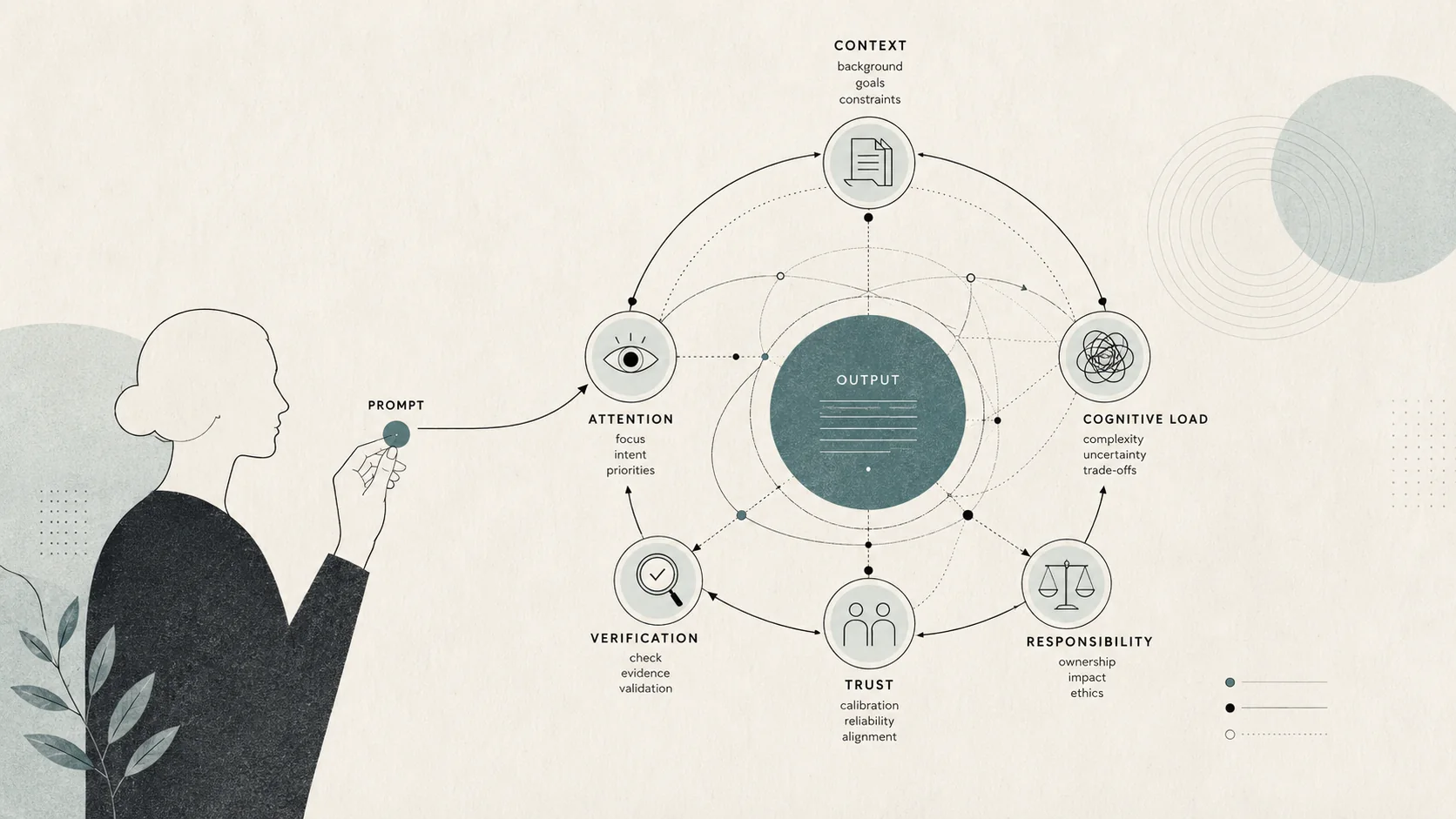
Public conversations about AI often stop at prompts. We learn how to write a better instruction, add a role, specify the format, define the audience, or ask for a particular style. This is understandable. A prompt is visible. It can be saved, compared, improved and shared as a simple recipe.
The prompt matters. A better question can clarify intention, expose missing context and make the first answer more useful. But it is only the visible part of the work. The harder part begins when the model answers and that answer starts to function as a note, a message, an argument, a recommendation, a report or a decision.
At that point, the question is no longer only “Was the prompt good?” It becomes: what exactly did we receive, what was missing, what must be checked, how much should we trust it and who takes responsibility for using it?
This is why AI literacy cannot be reduced to prompt engineering. It includes the ability to build context, understand model limits, notice one’s own confidence, verify information and decide what role an AI-generated answer should have in human work.
The prompt is an interface, not the competence
A prompt is an interface between human intention and a system that processes language. A good prompt can include a goal, context, constraints, expected format and tone. It can also force the user to name what they actually want.
But the prompt does not guarantee the quality of the answer. The result also depends on the available context, the information given to the model, the system’s limits and the user’s later interpretation. A sentence typed into a chat box does not solve the problems of trust, verification or responsibility.
One useful way to see this is through the idea of a token. A token is not a word in the human sense. It is a technical unit used by a model when processing text. This matters because the apparently natural conversation has hidden limits: length, cost, context and how much text can be handled at once.
The same is true of the context window. If the model does not have the relevant background, documents, constraints or prior agreements in its available context, a better prompt will not magically supply them. The model may still answer fluently, but outside the situation that matters.
Prompting is therefore not the whole competence. It is the first move in a longer human-AI process.
The model does not know what you did not provide
The phrase “the model does not know” is only a shortcut. A language model does not know in the human sense. It generates output from the input, available context and learned statistical patterns. If the user leaves out important information, the answer can still sound complete.
In practice, people often assume that the system understands more than it has been given. They ask for a strategy without explaining the organization, for a legal-sounding paragraph without the legal context, or for a recommendation without the relevant constraints. Sometimes the answer looks as if the system has understood the whole situation. That can be misleading.
This is where a mental model matters. Every user brings some idea of what AI is doing. If that model is too human, the user may treat the answer as evidence of understanding. If it is too mechanical, the user may miss how strongly the language of the answer shapes their judgment.
A poor mental model can lead to misplaced trust. The user may assume that the system remembers, understands or knows, when in practice it is operating within a bounded context and producing a model output that still needs interpretation.
Good AI work can reduce and increase cognitive load
AI can genuinely reduce effort. It can organize notes, shorten documents, suggest structures, draft a first version and help people move past the blank page. There is no need to pretend that this is not useful.
At the same time, AI can increase cognitive load. The user may receive more material faster, but now has to evaluate, compare, correct, source-check and place it in context. Instead of writing from scratch, the user may start managing versions of a text that already sounds polished.
This changes where attention goes. The model can reduce the effort of generation while increasing the effort of verification. It can make it easier to start and harder to stop. It can create a feeling of progress before the user knows whether the result is reliable.
In teams, this load becomes social. If people do not share rules for marking AI-generated material, checking sources and deciding what can leave the organization, the cost moves to someone else. Someone has to ask where a sentence came from. Someone has to check whether a claim is supported. Someone has to decide whether a text is a draft, a suggestion or a usable document.
Sometimes the most important prompt is a question to yourself
Working with AI is not only about what we ask the system. Sometimes the more important question is what we ask ourselves before using the answer.
These are metacognitive questions. Metacognition means monitoring and regulating one’s own thinking: what I know, what I do not know, how confident I am and when I should pause. In AI use, this matters because the model often gives us text that already looks ready.
Without this pause, a person may confuse fluency with accuracy, speed with quality and a professional tone with credibility. They may also fail to notice that they are delegating not only writing, but part of selection, framing and judgment.
This does not mean every AI interaction needs a heavy procedure. It means that mature AI use includes naming the status of the answer: draft, inspiration, summary to verify, argument to test, source request, or material that should not be sent without another person reading it.
Fluent does not mean true
Language models can produce answers that are smooth, coherent and confident. That is useful, but it creates a familiar risk: a text that is easy to read can feel more reliable than it deserves.
This is why epistemic vigilance matters. In plain language, it means staying attentive to information, sources and the reasons something feels credible. It is not cynicism. It is a habit of asking what supports a claim and whether the answer should be used as a source, a suggestion or only a starting point.
Trust in AI should not work as an all-or-nothing attitude. The better idea is calibrated trust: matching the level of trust to the task. A title suggestion, a summary of a known document, an interpretation of research and a recommendation signed by a manager do not require the same level of checking.
This is also where cognitive offloading becomes useful. Using a tool can move part of cognitive work outside the person. That is not automatically good or bad. The question is what has been moved: memory, drafting, selection, interpretation, style, judgment or responsibility.
From prompting to responsible collaboration
Organizations do not only need libraries of prompts. They also need shared ways of using the answers those prompts produce.
A communications team may ask a model to draft a message for a client. The prompt may be sensible. It may include the audience, purpose, tone and format. The answer may sound professional. Still, the important questions remain: are the facts correct, is any confidential information included, did the model add context that was not provided, who signs the final version and when should another person review it?
This is the everyday terrain of Human-AI Interaction. AI does not operate in an empty space. Its outputs enter documents, decisions, teams, relationships and institutions. The human side of AI is not only how people talk to models, but how model outputs travel through work.
The point is not to stop teaching prompts. Better questions still matter. The point is to stop mistaking the first visible step for the whole practice.
It is not just about the prompt. It is about who asks, what context is available, what the answer becomes and what people do with it next.
The note OpenAI, ChatGPT, GPT and LLM: What Is the Difference? separates the product, model family and technology category behind that interaction.
References
- Anthropic. (n.d.). Context windows. Claude Platform Docs. Retrieved July 2, 2026, from https://platform.claude.com/docs/en/build-with-claude/context-windows
- Flavell, J. H. (1979). Metacognition and cognitive monitoring: A new area of cognitive-developmental inquiry. American Psychologist, 34(10), 906-911. https://psycnet.apa.org/record/1980-09388-001
- Lee, J. D., & See, K. A. (2004). Trust in automation: Designing for appropriate reliance. Human Factors, 46(1), 50-80. https://journals.sagepub.com/doi/10.1518/hfes.46.1.50_30392
- OpenAI. (n.d.). Key concepts. OpenAI API documentation. Retrieved July 2, 2026, from https://developers.openai.com/api/docs/concepts
- OpenAI. (n.d.). What are tokens and how to count them? OpenAI Help Center. Retrieved July 2, 2026, from https://help.openai.com/en/articles/4936856-what-are-tokens-and-how-to-count-them
- Parasuraman, R., & Riley, V. (1997). Humans and automation: Use, misuse, disuse, abuse. Human Factors, 39(2), 230-253. https://journals.sagepub.com/doi/10.1518/001872097778543886
- Schraw, G., & Moshman, D. (1995). Metacognitive theories. Educational Psychology Review, 7(4), 351-371. https://digitalcommons.unl.edu/edpsychpapers/40/
- Sperber, D., Clément, F., Heintz, C., Mascaro, O., Mercier, H., Origgi, G., & Wilson, D. (2010). Epistemic vigilance. Mind & Language, 25(4), 359-393. https://discovery.ucl.ac.uk/id/eprint/1331363/
- Sweller, J. (1988). Cognitive load during problem solving: Effects on learning. Cognitive Science, 12(2), 257-285. https://www.sciencedirect.com/science/article/pii/0364021388900237
Suggested citation
Mamczur, F. (2026, March 12). It is not just about the prompt. Prompted Psyche. https://promptedpsyche.com/articles/it-is-not-just-about-the-prompt/
© 2026 Feliks Mamczur / Prompted Psyche. All rights reserved. Short quotations are permitted only with attribution to the author, the title and a link to the source.