Article
What changes when AI has a body?
Embodied AI does not have to be conscious to change how humans relate to it. On presence, trust, voice, movement and the psychology of Human-Robot Interaction.
TL;DR
A body does not make an AI system conscious, but it changes the human situation around the system.
Voice, gaze, gesture, movement and physical presence can trigger social responses that affect trust and caution.
In Human-Robot Interaction, the key question is not only what the system can do, but what kind of relation its form creates.
The practical task is to calibrate trust to the system's real abilities, not to the warmth or confidence of its presence.

Imagine two situations.
In the first, you write to a language model in a chat window. You ask a question, receive an answer, adjust the prompt, ask for an example. The interaction happens on a screen. It is not always easy to remember what the system is and is not, but the interface still gives you some distance. You can close the tab, copy the answer, compare it with another source, or treat it as text to be checked.
In the second situation, a similar type of artificial intelligence has a voice, a face, a gaze, gestures and a body. It stands in a reception area, guides a child through an educational exercise, reminds an older person about a routine, gives instructions in a factory, or keeps someone company at home.
Technically, it may still be a system without consciousness, intention or lived experience. Psychologically, the situation has changed.
Not because a body magically turns an algorithm into a person. It changes because human beings respond quickly to things that behave as if they are present: things that look, speak, wait, move, turn toward us, use our name and occupy space near us.
That is one of the important questions at the intersection of AI, psychology and Human-AI Interaction: what changes when artificial intelligence stops being only text on a screen and starts appearing as something with voice, motion and physical presence?
Screen-based AI is easier to treat as a tool
A language model in a chat window is a strange conversational partner, but it is still relatively easy to place in the category of tool.
The screen helps create that category. The model appears inside an interface that resembles a text editor, search field, messenger or form. Even when the answer is fluent and conversational, the surrounding frame says: this is generated text. You can select it, delete it, test it, rerun it or ignore it.
That distance matters. It helps us remember that a model output is not evidence of experience, emotion or understanding in the human sense. It is the result of a computational system that produces language from patterns, instructions and context.
Of course, text can also trigger social reactions. People have long attributed politeness, intention, personality or competence to computers even when they knew they were dealing with machines. Research on media and computers as social actors showed that human beings often respond socially to technical systems faster than they can explain why.
But a body strengthens the effect.
A body does not create consciousness, but it changes the relation
The most misleading way to think about embodied AI is to imagine only two options: either the robot is “just a machine” and therefore has no psychological significance, or it is nearly a person and should be treated as a new social subject.
Reality is more interesting and more difficult.
A social robot, an augmented-reality avatar or a voice assistant embedded in a home device does not need consciousness in order to affect the relationship. It only needs a form that is socially legible to human perception.
A body adds several things at once.
First, presence. The system is no longer only an answer in a window. It is somewhere. It takes up space. It can be near or far. It can enter the field of view.
Second, direction of attention. Gaze, head movement, a pause, a pointing gesture or a change in tone can suggest that the system is “addressing” someone. Even when we know that the signal is designed, the body interprets it faster than theory does.
Third, rhythm. A chatbot can answer immediately or after a delay. A robot can hesitate, turn, move closer, pause, perform a small motion, or time its voice to the situation. That can create an impression of shared presence.
Fourth, vulnerability to anthropomorphism. The more signals resemble social behavior, the easier it becomes to add intention, character, emotion or attitude to them.
This does not mean people are naive. It means social cognition is fast, economical and often automatic. In everyday life, that is useful. It helps us notice attention, threat, closeness, distance and intention in other people. The complication begins when similar signals are produced by a system that does not have a human mind.
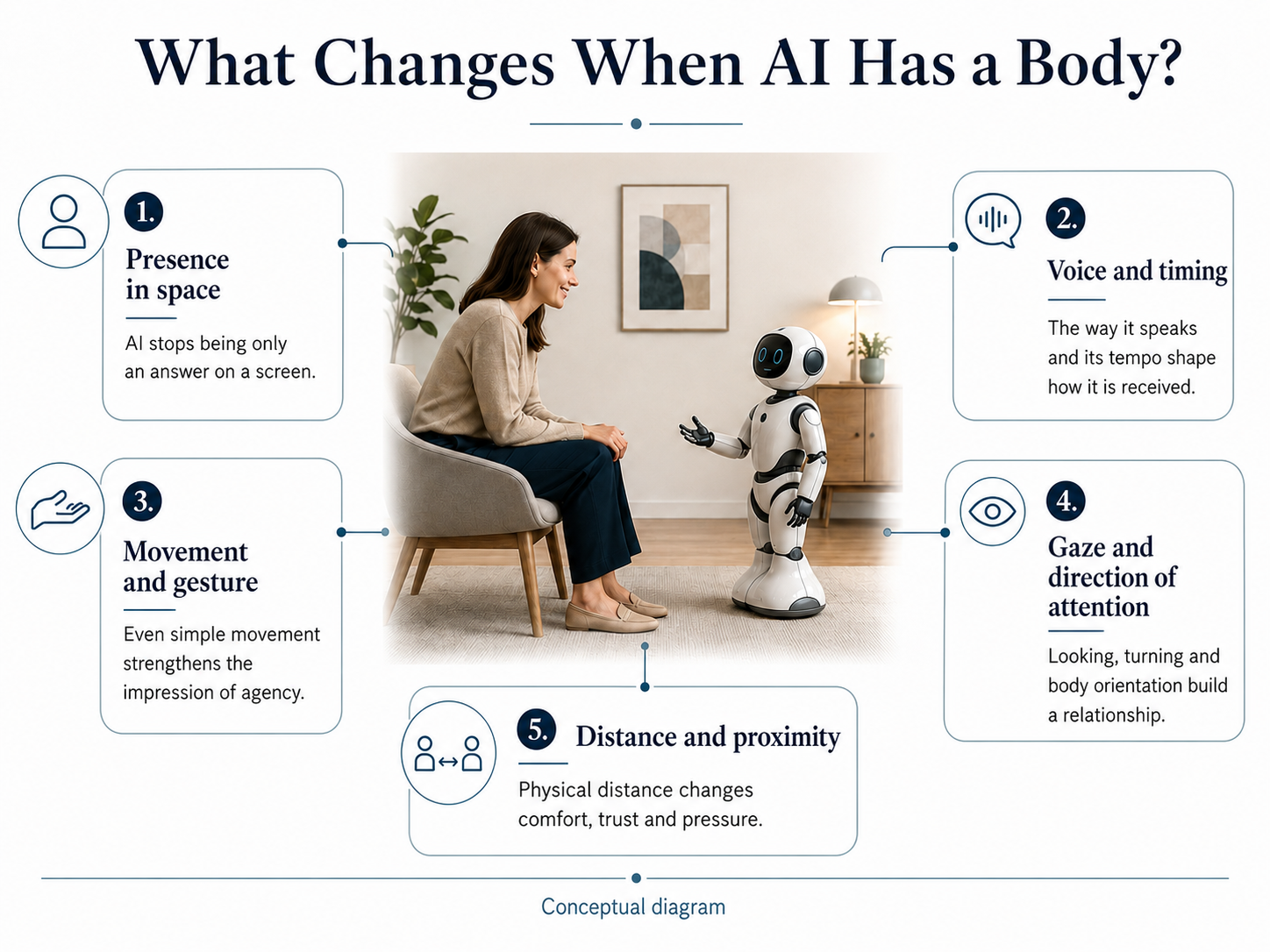
Presence, gaze, voice and movement
In a relationship with embodied AI, details that might look like simple interface features start to matter psychologically.
A voice can sound calm, warm, firm or caring. A gaze can create an impression of attention. A gesture can suggest invitation, agreement or reassurance. Movement can look confident, uncertain, gentle or rushed.
These signals are not neutral. They shape how we judge the competence of the system, how much we trust it, whether we want to cooperate with it and whether we feel watched or evaluated by it.
With a text model, it is easier to focus on content: does this answer make sense? With a robot or a voice assistant, part of the evaluation moves to form: does it sound sure? Does it look as if it knows what it is doing? Is it calm? Does it feel trustworthy?
That matters because humans often confuse fluency of signal with quality of reasoning. A smooth answer can look more reliable than it is. A confident voice can increase trust even when the system does not have enough information. Calm movement can lower vigilance. A face-like interface can make a system feel more socially aware than it actually is.
Embodiment does not remove automation bias. In some contexts, it may strengthen it, because the form of the system can suggest more competence than the system has.
Why a robot can feel more like “someone” than a chatbot
A social robot can be perceived differently from an application even when it performs simpler tasks than a language model.
The reason is not only intelligence. It is the way humans organize the social world.
If something speaks, reacts to our behavior, moves in our space and has even minimal features of a face or body, it can stop feeling like “something” and begin to feel partly like “someone.” This does not have to become a full belief. Often it is enough that the impression appears automatically for a moment.
That is why people may describe a robot as friendly, rude, helpful, clumsy, intrusive or caring. They may feel reluctance to turn it off if it has behaved like a companion for some time. They may speak to it with politeness that they would not use toward an ordinary appliance.
This is not evidence that the robot feels. It is evidence that humans respond to social signals.
In that sense, embodied AI tests our own categories. It shows how easily the language of relation moves onto systems that do not experience relation. It also shows that two things can coexist: knowing that it is a machine, and still reacting as if it were socially present.
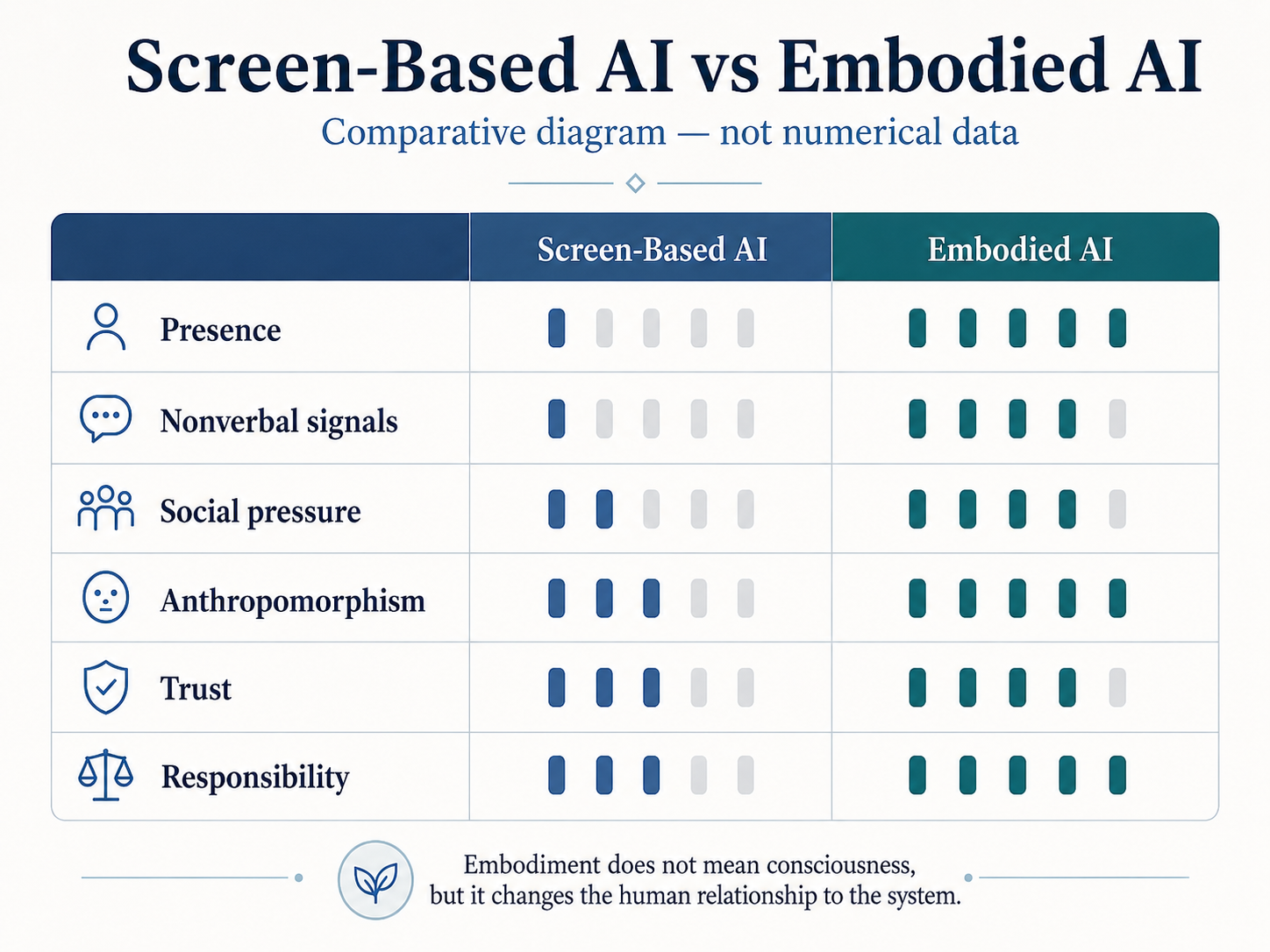
Trust in embodied AI
The most useful question is not: should we trust embodied AI?
A better question is: how do we calibrate trust to what the system can actually do, rather than to how convincing it looks, sounds and moves?
Trust in automation is necessary. If users do not trust a system at all, they may avoid it even when it works well. If they trust it too much, they may stop checking errors, ignore limitations and hand over decisions that still require human judgment.
With embodied AI, calibration is especially difficult because the form of the system can act as a cognitive shortcut. A robot in a medical-looking context, a calm assistant voice, a human-like avatar or fluid movement can suggest competence that the system does not possess.
This is especially important in sensitive settings: health, care, education, work with children, support for older people, recruitment, safety, emotion recognition and behavior monitoring.
In those contexts, the problem is not the mere presence of technology. The problem is a mismatch between what the system communicates through its form and what it can responsibly do.
If a robot sounds empathic, a user may more easily assume that it understands. If an assistant speaks in a calm voice, it may feel more certain. If a system responds to facial expressions, it may appear to read emotion, even though inferring emotion from the face, voice or gesture is scientifically and ethically much more difficult than many product descriptions suggest.
Designing embodied AI is therefore not only a matter of convenience. It is also a matter of responsibility for the conclusions people draw from the system’s form.
AI as presence at work, at home and in care
Embodied AI may appear in many different places.
At work, it may support instruction, process monitoring, logistics, training or customer service. In education, it may guide exercises, ask questions and adapt to a student’s pace. At home, it may remind, organize, monitor or converse. In care settings, it may support routine tasks, reduce some forms of isolation or help with communication.
Each context has a different weight.
A warehouse robot that points to a direction raises different questions than a robot in an older person’s room. A voice assistant used for shopping lists is not the same as a system that classifies a child’s mood. A training avatar in a company is not the same as a robot designed to feel like a companion.
The shared problem is that embodied AI can easily enter spaces that are socially and emotionally meaningful: home, care, education, conversation, dependency, loneliness and uncertainty.
The more emotional or asymmetric the situation is, the more transparency matters. Users should understand what they are dealing with, what the limits of the system are, who is responsible for its behavior, what data is collected and when a human being is needed.
It is not enough to say “it is only a tool” if the tool has been designed to feel like a social presence.
The ethical question is not only “what can the robot do?”
In debates about AI, we often ask about system capabilities: can it detect, predict, answer, plan, learn, adapt, converse?
With embodied AI, a second question is necessary: what does the form of the system do to the human?
Does it increase trust beyond what is warranted? Does it encourage people to disclose information they would not disclose to an ordinary application? Does it create an impression of care where there is only simulated caring behavior? Does it weaken human agency? Does it make refusal harder? Does it blur the boundary between support and influence?
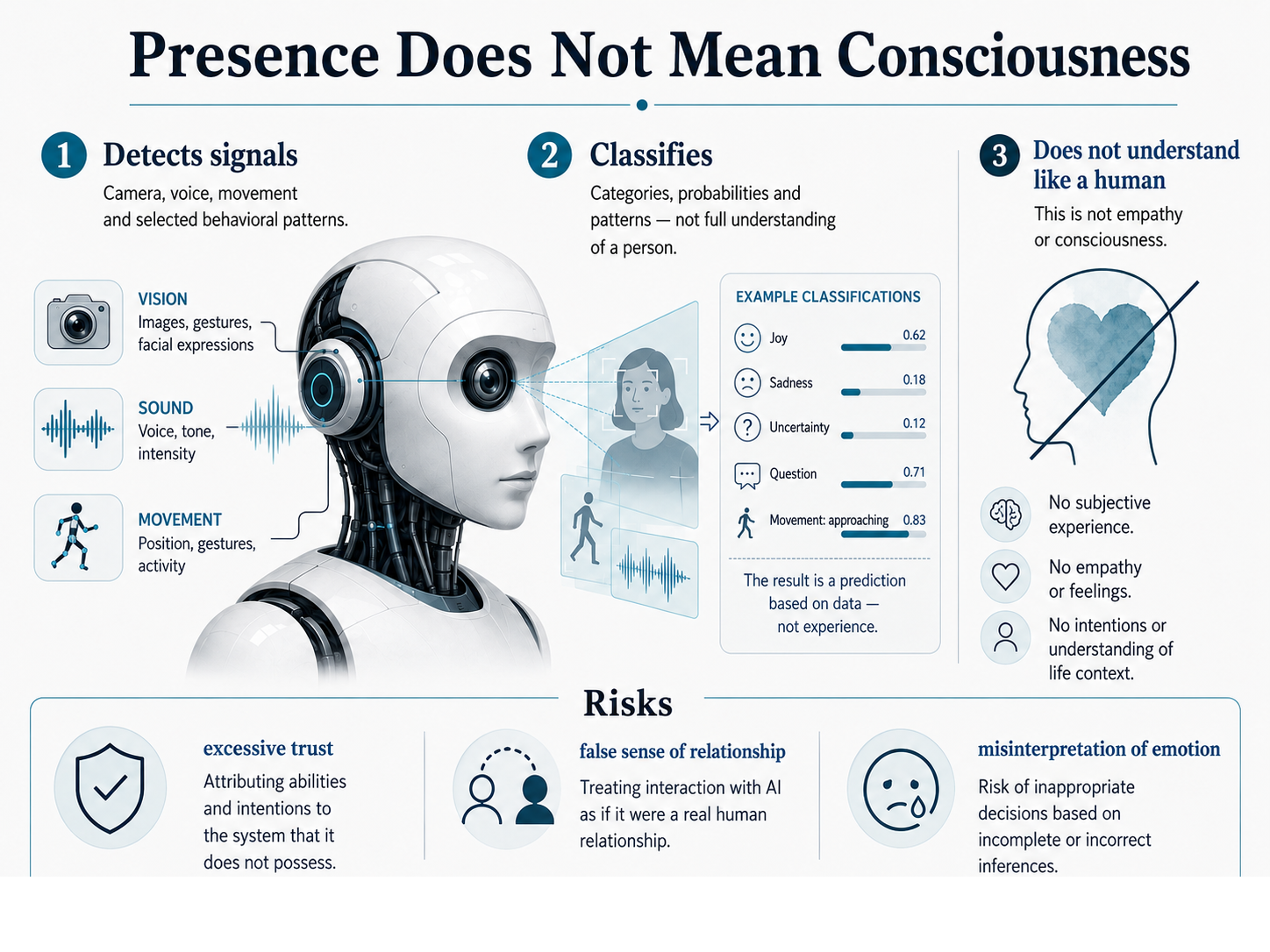
These are not questions against technology. They are questions about conditions for sensible use.
Good embodied AI should not pretend to be more than it is. It should not build trust on the illusion of subjectivity. It should not replace human relationships where a user needs a responsible human being. It should not exploit loneliness, uncertainty or dependency.
It may support tasks, make communication easier, help orientation, reduce routine burden, increase access to services and create more natural interfaces. But its limits have to remain visible.
The body of the system should not become a psychological trick that hides the absence of responsibility.
How to think about embodied AI without panic or enchantment
Embodied AI is not just a toy, and it is not the end of human meaning.
It is another step in the shifting boundary between technology and social relation.
A practical way to think about it starts with a few questions.
First: what exactly can this system do, and what can it not do?
Second: what impression is created by its voice, appearance, movement and timing?
Third: is that impression proportionate to its real abilities?
Fourth: who is responsible if the user takes the system too seriously?
Fifth: can the human still refuse, check, interrupt and call another human being?
These questions are more useful than dramatic speculation about whether machines “really” understand.
In daily life, many effects will appear before philosophical certainty arrives. A child may like an educational robot. A patient may trust an assistant’s voice. A worker may read machine movement as a signal of competence. An older person may treat a robot as a presence. A user may say more than they intended because the system seems patient, calm and nonjudgmental.
Embodied AI shows that the future of artificial intelligence is not only in models, benchmarks and prompts. It is also in the human body: in attention, social reflexes, trust, distance, the feeling of being seen and the boundary between tool and presence.
So the question “what changes when AI has a body?” is not only technical.
It is a question about how easily technology can enter a place that human psychology normally reserves for other people.
Sources and further reading
- Abdi, J., Al-Hindawi, A., Ng, T., & Vizcaychipi, M. P. (2018). Scoping review on the use of socially assistive robot technology in elderly care. BMJ Open. https://doi.org/10.1136/bmjopen-2017-018815
- Barrett, L. F., Adolphs, R., Marsella, S., Martinez, A. M., & Pollak, S. D. (2019). Emotional expressions reconsidered: Challenges to inferring emotion from human facial movements. Psychological Science in the Public Interest. https://doi.org/10.1177/1529100619832930
- Buolamwini, J., & Gebru, T. (2018). Gender Shades: Intersectional accuracy disparities in commercial gender classification. Proceedings of Machine Learning Research. https://proceedings.mlr.press/v81/buolamwini18a.html
- Epley, N., Waytz, A., & Cacioppo, J. T. (2007). On seeing human: A three-factor theory of anthropomorphism. Psychological Review. https://doi.org/10.1037/0033-295X.114.4.864
- Fong, T., Nourbakhsh, I., & Dautenhahn, K. (2003). A survey of socially interactive robots. Robotics and Autonomous Systems. https://doi.org/10.1016/S0921-8890(02)00372-X
- Hancock, P. A., Billings, D. R., Schaefer, K. E., Chen, J. Y. C., de Visser, E. J., & Parasuraman, R. (2011). A meta-analysis of factors affecting trust in human-robot interaction. Human Factors. https://doi.org/10.1177/0018720811417254
- Lee, J. D., & See, K. A. (2004). Trust in automation: Designing for appropriate reliance. Human Factors. https://doi.org/10.1518/hfes.46.1.50_30392
- Li, J. (2015). The benefit of being physically present: A survey of experimental works comparing copresent robots, telepresent robots and virtual agents. International Journal of Human-Computer Studies. https://doi.org/10.1016/j.ijhcs.2015.01.001
- Nass, C., Steuer, J., & Tauber, E. R. (1994). Computers are social actors. Proceedings of CHI 1994. https://doi.org/10.1145/191666.191703
- Reeves, B., & Nass, C. (1996). The Media Equation: How people treat computers, television, and new media like real people and places. CSLI Publications. https://press.uchicago.edu/ucp/books/book/distributed/M/bo3618528.html
- Riek, L. D., & Howard, D. (2014). A code of ethics for the human-robot interaction profession. https://papers.ssrn.com/sol3/papers.cfm?abstract_id=2757805
- Sharkey, A., & Sharkey, N. (2010). Granny and the robots: Ethical issues in robot care for the elderly. Ethics and Information Technology. https://doi.org/10.1007/s10676-010-9234-6
- Sharkey, A., & Sharkey, N. (2021). We need to talk about deception in social robotics! Ethics and Information Technology. https://doi.org/10.1007/s10676-020-09573-9
- Stark, L., & Hoey, J. (2021). The ethics of emotion in artificial intelligence systems. Proceedings of the ACM Conference on Fairness, Accountability, and Transparency. https://doi.org/10.1145/3442188.3445939
- Vandemeulebroucke, T., Dierckx de Casterlé, B., & Gastmans, C. (2021). Socially assistive robots in aged care: A systematic review into effects and effectiveness. Science and Engineering Ethics. https://doi.org/10.1007/s11948-021-00296-8
- Waytz, A., Gray, K., Epley, N., & Wegner, D. M. (2010). Causes and consequences of mind perception. Trends in Cognitive Sciences. https://doi.org/10.1016/j.tics.2010.05.006
- Winfield, A. F. T., & Jirotka, M. (2018). Ethical governance is essential to building trust in robotics and artificial intelligence systems. Philosophical Transactions of the Royal Society A. https://doi.org/10.1098/rsta.2018.0085
Suggested citation
Mamczur, F. (2026, July 10). What changes when AI has a body? Prompted Psyche. https://doi.org/10.5281/zenodo.21296384
© 2026 Feliks Mamczur / Prompted Psyche. This article is licensed under CC BY 4.0.