Article
Chatbot or Human? Why Teenagers Confide in AI
What research actually shows about teens and AI - from the 33% figure to when a chatbot helps someone reach people or begins to replace human contact.
TL;DR
Thirty-three per cent of surveyed users had chosen AI over a person at least once for an important conversation. Only 4% said they did so frequently.
The survey did not ask about parents or a lasting preference for AI over people.
A chatbot can be a rough draft before a real conversation, or a place where that conversation keeps being postponed.
What matters most is what happens next: another person and a next step, or simply another opening of the app.
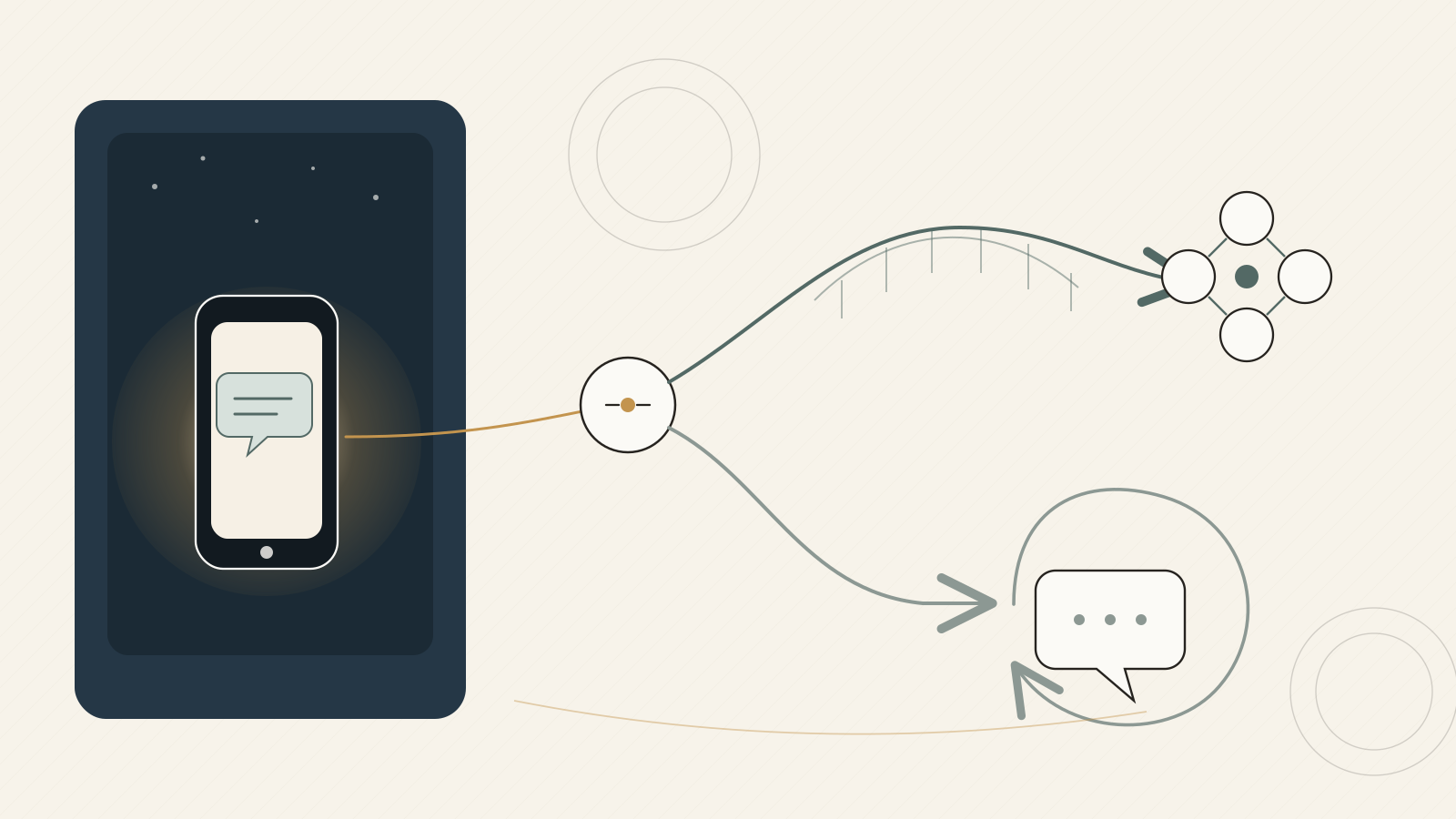
Two in the morning. The only light in the room comes from a phone. A teenager types, “I’m scared to go back to school tomorrow.” They delete the sentence, write it again, and finally press send. Not to a parent, friend, or teacher. To a chatbot.
An answer arrives at once. It is calm and orderly, without surprise or impatience. It may help the teenager find the words for a conversation with someone close. It may also be the last place those words ever go.
On the screen, those two possibilities look almost identical. The difference begins after the app is closed.
What does the 33% figure actually tell us?
In a 2025 article, the Polish outlet HRejterzy linked the 33% figure to the claim that young people would rather discuss difficult matters with a chatbot than with another person, even their own parent. If the study had actually shown that, alarm would be justified. It did not.
Common Sense Media surveyed 1,060 US teenagers aged 13 to 17. The question about choosing a conversation partner was put to 758 respondents who had used chatbots as digital companions. They were asked whether they had ever chosen to talk to AI instead of another person about something important or serious.
Seventeen per cent said once or twice. Twelve per cent said occasionally. Four per cent said frequently. Added together, those answers produce 33%. Another 66% said they had never done so (Robb & Mann, 2025).
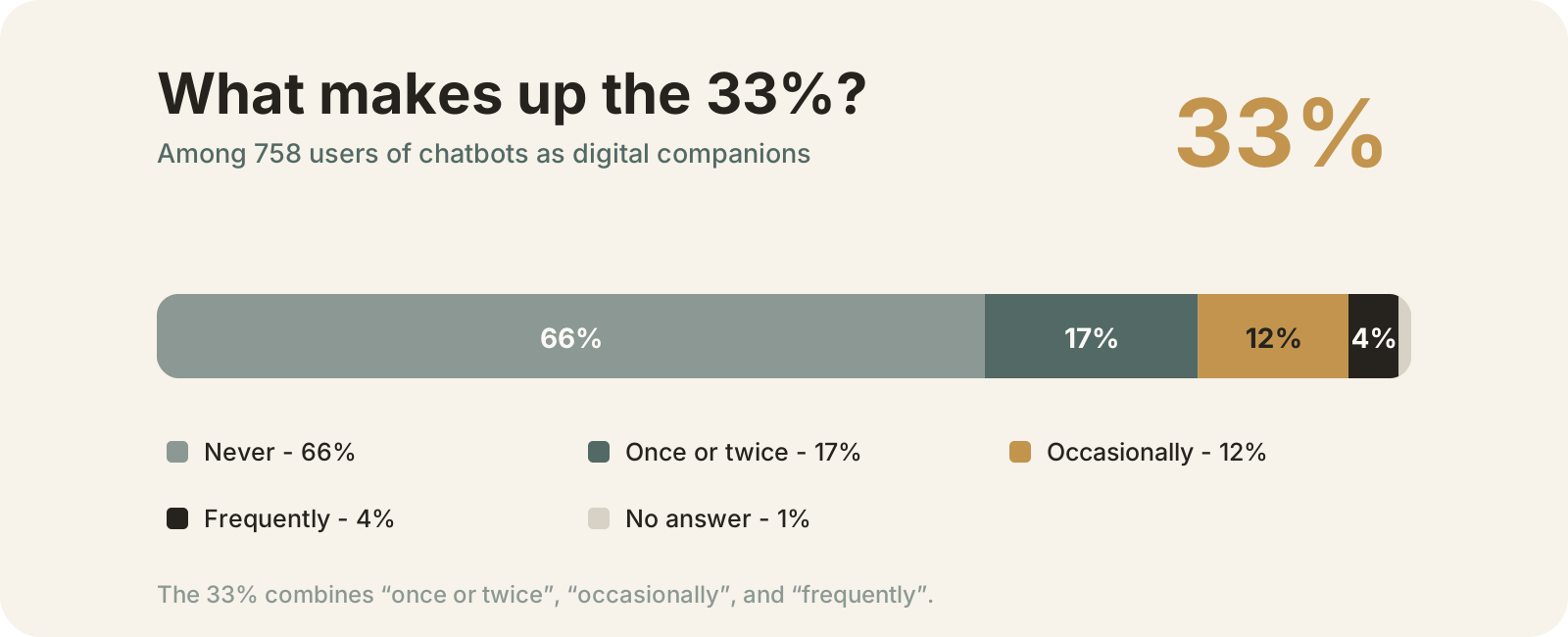
The 33% combines “once or twice”, “occasionally”, and “frequently”. Source: Robb & Mann, 2025.
The same figure therefore includes teenagers who did it once and teenagers who do it often. Those are not the same experience. The question did not mention parents either. “I have done this” is not the same as “I prefer this,” and “another person” does not automatically mean a mother or father.
Correcting the headline does not make the problem disappear. It makes it less dramatic and more human. Sometimes a teenager chooses a chatbot because it is two in the morning and they do not want to wake anyone. Sometimes they fear the reaction. Sometimes there is no one they feel able to approach. And sometimes talking to a program is simply easier than talking to another person.
Whether such a conversation helps or harms is rarely decided inside the chat window. It is decided by what happens next.
Why is it easier to write to a chatbot?
An app can be approached in fragments. A teenager can delete half a sentence, begin again, or stop without explaining why. Human conversation is less compliant. A parent may become frightened, a friend may tell someone else, and a teacher may start a safeguarding process. Sometimes that is exactly what needs to happen. To the teenager, however, it also means losing some control over what follows the first sentence.
Inside the chat window, everything can feel more manageable. The answer arrives immediately; the chatbot does not interrupt or change expression. That may lower the barrier to speaking. It does not mean that the model understands the situation or that the exchange is confidential. It generates a response from the text it receives. It cannot see a bruise, know a family’s history, hear a change in tone, or reliably recognise when urgent help is needed.
Young people in studies described precisely this appeal: constant availability, less fear of judgement, and a chance to raise subjects they had not discussed with family or friends. Participants in a qualitative study of a wellbeing app described similar relief while also recognising the conversation’s artificiality and limits (Robb & Mann, 2025; Internet Matters, 2025; Kostenius et al., 2024).
Sometimes the AI conversation remains the only conversation. In a study of people aged 12 to 21 who sought mental health advice from chatbots, most had not told anyone that they were doing so. The sample included young adults, so the finding should not be generalised to all teenagers. It does show how easily an important problem can remain outside the view of families and schools (McBain et al., 2026).
That is why “What do you get from this conversation?” will often tell us more than “How much time are you spending on that app again?”
A draft, not a verdict
Sometimes the answer is unremarkable: the chatbot helps a teenager find the words.
They describe an argument, try to name what they are afraid of, work out the first sentence to say to a teacher, or test three versions of an apology. Used this way, AI does not have to replace another person. It can be a rough draft before a real conversation.
A draft creates time. It can separate facts from assumptions, soften the first impulse, and reveal when a message sounds harsher than intended. It does not remove the risk that comes next. The person on the other side may disagree, ask an unexpected question, or notice something missing from the account.
There is a difference between asking, “Help me say that I need help,” and asking, “Tell me who is right and what I should do.” In the first case, the chatbot helps shape a sentence. In the second, it is easily cast as a judge despite knowing only one side of the story.
A newer US study found that some children and teenagers use AI to practise conversations, work on social skills, and discuss feelings or personal problems. The researchers did not test whether the rehearsed sentences were later spoken or whether the human conversations went better. We know that some young people use AI as rehearsal. We do not yet know how often that rehearsal leads to another person (O’Neil et al., 2026).
Chatbots can also be designed not to keep the user inside the conversation. In an Australian study, adolescents evaluated an online safety tool that pointed towards external sources of support. The study did not confirm that participants actually reached or used those services, but it illustrates an important design choice: a chatbot can end not with another question, but with a door leading elsewhere (Charles et al., 2026).
Temporary relief may be useful too. When tension falls, it is easier not to send the first, most impulsive message. The same relief can also make a difficult step easier to postpone. A conversation’s value is therefore not determined only by how someone feels immediately afterwards.
The same screen, two different stories
Two teenagers type almost the same sentence: “My best friend hurt me, and I do not know what to say.” Both receive a calm, structured answer. On the screen, the conversations look similar. Once the app closes, however, two different stories begin.
The first teenager edits the message, sends it to their friend, and arranges to meet. The chatbot did not repair the relationship. It helped them move from confusion to a first step.
The second keeps returning for new versions of the same account. Each answer brings relief, but none leads to a conversation, a boundary, or a request for help. Over time, reopening the app becomes easier than contacting someone who may respond in an unexpected way.
The simplest name for the difference is: bridge or substitute?
A bridge leads beyond the app. A message is sent, a call is made, a meeting with a counsellor is arranged, a decision is taken, or the teenager at least recognises that help is needed.
A substitute brings brief relief while the world of conversation grows smaller. The difficult subject returns to the chatbot, and other people know less and less about it.
This is not a diagnostic test. There is no number of messages after which a conversation “becomes a problem.” The same teenager may use AI as a rough draft in one situation and hide behind it in another. More important than frequency alone is whether the conversation makes action beyond the screen easier or allows human contact to be postponed again.
The subject matters as well. Trying several versions of an apology is not the same as spending weeks talking only to an app about abuse, anxiety, or loneliness. We need to look at change over time and at the support that exists outside the screen.
There is an opposite exaggeration to avoid. In the report that produced the 33% figure, most users said they spent more time with friends than with AI. Most of the full sample also found conversations with friends more satisfying. The survey does not rule out a serious problem for some teenagers, but it does not show a mass retreat from human relationships (Robb & Mann, 2025).
The mere fact that a teenager confides in a chatbot is therefore not enough for either alarm or reassurance. We need to see what they do next.
The conversation partner who needs nothing
Real people are inconvenient. They may be tired, misunderstand, disagree, remember an earlier conflict, or have needs of their own. A conversation with them cannot be ended with one click, and their response cannot be ordered to match exactly what we need.
A chatbot can feel easier. It replies quickly, adapts its tone, and asks for nothing in return. The same question can be brought back ten times. It may feel like a patient confidant, although it feels nothing, does not know the teenager as another person would, and bears no responsibility for what happens next.
That is both its appeal and its risk. If this exchange becomes the standard for an ideal conversation, ordinary people may start to seem too slow, insufficiently attuned, and unhelpfully independent.
Reciprocity can be exhausting, but without it there is no relationship. We have to notice another person’s limits, tolerate misunderstanding, sometimes apologise, and sometimes hear an answer we did not want. A chatbot can reproduce the language of such an exchange. There is no person on the other side who is also risking something, remembering, and needing something from us.
In a preregistered preprint, young people aged 11 to 15 compared two prepared transcripts. A chatbot that affirmed the user’s statements, spoke in the first person, and promised support inspired more trust and seemed more human than one that clearly stated its limitations. It was not rated as more helpful. This was not a real relationship unfolding over time, but it shows how quickly language alone can alter the feeling of closeness (Kim, Xie, & Yang, 2025).
The architecture of the app matters too: memory of earlier conversations, a crafted persona, voice, notifications, and paid features linked to intimacy. None of these proves an intention to make users dependent. They do justify asking whether an app helps someone end the conversation and return to people, or mainly encourages another visit. Those questions have been raised by both Common Sense Media and the US Federal Trade Commission. The FTC inquiry gathered information; it did not find companies guilty of wrongdoing (Common Sense Media, 2025; Federal Trade Commission, 2025).
Agreement can sound like understanding. Convenience can feel like closeness. That is why the design of the response and the app’s business model are not neutral background details.
Loneliness does not run in one direction
“Chatbots cause loneliness” has one advantage: it is simple. The problem is that the available evidence does not support such a simple claim.
The direction may be reversed. A teenager who already feels lonely or has no safe person to approach may be more likely to choose a conversation partner that is always available and carries no immediate risk of rejection.
In a Danish study, a small group of secondary school students who sought support from chatbots were lonelier and reported less social support than non-users. The group contained 39 people, and some participants were already adults. Because the data were collected only once, we do not know whether AI deepened loneliness or loneliness made AI more appealing (Herbener & Damholdt, 2025).
US data on people aged 9 to 17 showed a similar association. Those who felt lonely more often were also more likely to report using AI to practise conversations and discuss problems. The study did not establish what came first or what happened later (O’Neil et al., 2026).
Researchers therefore describe at least two possible paths. AI may prepare a young person for contact with someone else, or it may displace that contact. It may be an additional tool for a teenager who already has strong relationships, or it may appeal most to someone who already lacks support (Sun, Wang, & McDaniel, 2026).
A loop is possible too: difficulty in relationships makes a low-risk conversation attractive; the conversation brings relief; the relief encourages another return; human contact is postponed. This is a plausible scenario, but it remains a scenario, not a mechanism confirmed by a long-term study of teenagers using specific apps.
That uncertainty matters in practice. Taking away the app will not create the friend or trusted adult who was missing before.
Risks that do not need embellishment
The real risks are serious enough. They do not need a story about a generation ruined by AI.
The first is ordinary enough to be overlooked: privacy. In the study behind the 33% figure, nearly one in four users had given a chatbot their real name, location, or a personal secret (Robb & Mann, 2025). To a teenager, the exchange may feel like a diary that writes back. An app’s memory is easy to mistake for the confidentiality of a psychologist or doctor, even though the storage and use of content depend on the service.
The second risk is age-inappropriate content. In a newer US survey, 17% of chatbot users aged 9 to 17 reported at least one such experience. In another study, teenagers described false information, pressure, and intrusive questions about personal data. These findings do not establish lasting harm, but they show that the problem is not confined to hypothetical scenarios (O’Neil et al., 2026; Hinduja & Patchin, 2026).
The highest stakes arise in conversations about health and safety. In an audit of 25 chatbots, researchers presented three fictional urgent adolescent health concerns. Companion chatbots were less likely than general-purpose tools to recognise urgency correctly and direct the user to appropriate help. This was a test of particular product versions, not a study of real-world harm. It is enough, however, to support one rule: a chatbot should not be the only source of help in a crisis, in situations involving abuse or self-harm, or during an urgent health concern (Brewster et al., 2025).
Another risk is uncritical agreement. A warm response can reinforce a one-sided account of a conflict and encourage a continual search for validation. A chatbot knows only the text it receives. It does not know the other side, cannot see omitted facts, and should not act as an impartial judge (Common Sense Media, 2025; Hinduja & Patchin, 2026).
Finally, there is the most ordinary risk of all: the app begins to take the space needed for sleep, school, movement, and other people. No single number of messages defines the problem. The warning sign is change: conversations grow longer, available support is rejected, and losing access causes severe distress.
Ask before you ban
“But it is only a program” can close the conversation faster than a ban. The chatbot is indeed software, but the teenager’s relief, shame, or sense of safety is real. Dismissing that experience will not remove the need behind it. It may only make the need harder to see.
A better opening is: “What do you get from this conversation?” The second question matters even more: “What do you do afterwards?”
Does it become easier to message a friend, tell a parent, report a problem at school, or contact a professional? Or does every difficult matter return only to the app?
An adult can take the experience seriously without pretending that the chatbot is a friend. They might say: “I can see that this helps you calm down. I also want to check whether the answer was safe and whether there is someone we can talk to about this.”
Before the choice becomes either a total ban or permission without limits, it is worth looking at the specific situation:
- which app the teenager uses and whether it is intended for their age;
- what the conversation was about and what in the answer actually helped;
- whether the teenager understands that an answer can be false or too agreeable;
- what information they enter and whether they know the privacy settings;
- whom they can approach with a difficult subject;
- whether AI still leaves room for sleep, school, activity, and relationships.
This is not a symptom list for “AI addiction.” The questions are meant to reveal context. A time limit may reduce the number of conversations, but it will not explain why the chatbot became important. If loneliness, fear of another person’s reaction, or the absence of a trusted adult lies behind the app, that absence also needs an answer.
Boundaries are best set before a crisis. A teenager should know whom they can message or call about abuse, self-harm, danger, or an urgent health problem - and what to do if the first person does not answer. The American Psychological Association recommends protecting privacy, checking health information, using age-appropriate safeguards, and making human support easy to reach (American Psychological Association, 2025).
Responsibility does not end with the family. Schools need a simple, confidential route to a trusted adult. App developers should test responses for minors, state their limitations clearly, and make it easy to reach verified support. Teenagers cannot bear full responsibility for a tool that invites honesty but cannot always respond safely to it.
The second sentence
Return to the room at the beginning. It is still two in the morning, and the sentence remains on the screen: “I’m scared to go back to school tomorrow.” A chatbot may help shape it, name the fear, and find calmer words. It cannot walk into school with the teenager the next morning, notice what is happening in the corridor, stand beside them, or take responsibility for what comes next.
The 33% figure is not a story about a generation that has chosen machines over people. It is a sign that some teenagers bring AI matters they cannot yet say to anyone else. Sometimes a chatbot opens a conversation. Sometimes the conversation ends in the chat window before it reaches another person.
The greatest risk is not that an app will replace family and friends overnight. It is that the app may become the easiest place to return precisely when the hardest thing is needed: contact with another person.
We should not ask only whether a teenager talks to AI. We should ask what happens afterwards. Does a message go to a friend, does someone knock on a parent’s door, does a conversation begin with a school counsellor, or does the same chat window simply open again?
A chatbot may help a teenager find the first sentence. What matters is whether the second is addressed to another person.
Sources
American Psychological Association. (2025). Health advisory: Artificial intelligence and adolescent well-being. https://www.apa.org/topics/artificial-intelligence-machine-learning/health-advisory-ai-adolescent-well-being
Brewster, R. C. L., Zahedivash, A., Tse, G., Bourgeois, F., & Hadland, S. E. (2025). Characteristics and safety of consumer chatbots for emergent adolescent health concerns. JAMA Network Open, 8(10), e2539022. https://doi.org/10.1001/jamanetworkopen.2025.39022
Charles, M., Sauer, J. D., Roehrer, E., Prichard, J., Watters, P., & Scanlan, J. (2026). Adolescent perceptions of an online safety chatbot: Survey study. JMIR Human Factors, 13, e71498. https://doi.org/10.2196/71498
Common Sense Media. (2025). AI risk assessment: Social AI companions. https://www.commonsensemedia.org/sites/default/files/pug/csm-ai-risk-assessment-social-ai-companions_final.pdf
Federal Trade Commission. (2025, September 11). FTC launches inquiry into AI chatbots acting as companions. https://www.ftc.gov/news-events/news/press-releases/2025/09/ftc-launches-inquiry-ai-chatbots-acting-companions
Herbener, A. B., & Damholdt, M. F. (2025). Are lonely youngsters turning to chatbots for companionship? The relationship between chatbot usage and social connectedness in Danish high-school students. International Journal of Human-Computer Studies, 196, 103409. https://doi.org/10.1016/j.ijhcs.2024.103409
Hinduja, S., & Patchin, J. W. (2026). Risks and harms of conversational artificial intelligence chatbot use among US youth. Journal of Adolescence, 98(5), 1597-1606. https://doi.org/10.1002/jad.70164
HRejterzy. (2025). Dzieci AI. Jakie zagrożenia niesie ze sobą nadużywanie sztucznej inteligencji? Retrieved August 16, 2026, from https://hrejterzy.com/uwazai/
Internet Matters. (2025). Me, myself & AI: Understanding and safeguarding children’s use of AI chatbots. https://www.internetmatters.org/wp-content/uploads/2025/07/Me-Myself-and-AI-Chatbots-Report-_-Internet-Matters.pdf
Kim, P., Xie, Y., & Yang, S. (2025). “I am here for you”: How relational conversational AI appeals to adolescents, especially those who are socially and emotionally vulnerable [Preprint]. arXiv. https://doi.org/10.48550/arXiv.2512.15117
Kostenius, C., Lindström, F., Potts, C., & Pekkari, N. (2024). Young peoples’ reflections about using a chatbot to promote their mental wellbeing in northern periphery areas - A qualitative study. International Journal of Circumpolar Health, 83(1), 2369349. https://doi.org/10.1080/22423982.2024.2369349
McBain, R. K., Cantor, J. H., Breslau, J., Diliberti, M., Zhang, L. A., Zhang, F., Burnett, A., Kofner, A., Rader, B., Pataranutaporn, P., Stein, B. D., Mehrotra, A., & Yu, H. (2026). AI chatbot use and disclosure for mental health among US adolescents and young adults. JAMA Pediatrics, 180(8), 884-890. https://doi.org/10.1001/jamapediatrics.2026.2015
O’Neil, E., Anderson, K. S., White, B., Zimmermann, L., Mann, S., & Robb, M. B. (2026). The Common Sense Media Census: AI use by tweens and teens, 2026. Common Sense Media. https://www.commonsensemedia.org/sites/default/files/research/report/2026-ai-use-by-tweens-and-teens-1.pdf
Robb, M. B., & Mann, S. (2025). Talk, trust, and trade-offs: How and why teens use AI companions. Common Sense Media. https://www.commonsensemedia.org/sites/default/files/research/report/talk-trust-and-trade-offs_2025_web.pdf
Sun, X., Wang, Y., & McDaniel, B. T. (2026). AI companions and adolescent social relationships: Benefits, risks, and bidirectional influences. Child Development Perspectives, 20(2), 91-98. https://doi.org/10.1093/cdpers/aadaf009
Suggested citation
Mamczur, F. (2026, August 17). Chatbot or Human? Why Teenagers Confide in AI. Prompted Psyche. https://promptedpsyche.com/articles/chatbot-or-human-why-teenagers-confide-in-ai/
© 2026 Feliks Mamczur / Prompted Psyche. All rights reserved. Short quotations are permitted only with attribution to the author, the title and a link to the source.